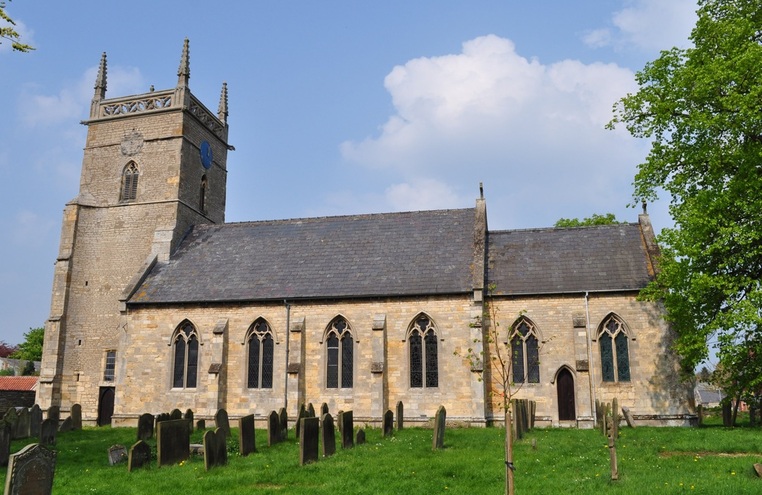
St. Andrew's Church
POTTERHANWORTH
LINCOLNSHIRE
6 BELLS, Tenor: 6 cwt - 3 qrs - 24 lbs (in C)
Bell Details
|
Bell. 1. 2. 3. 4. 5. 6. |
|
|
Weight. 2 cwt. 1 qr. 7 lbs. 2 cwt. 1 qr. 3 lbs. 2 cwt. 3 qrs. 5 lbs. 2 cwt. 3 qrs. 17 lbs. 4 cwt. 2 qrs. 18 lbs. 6 cwt. 3 qrs. 24 lbs. |
This is to allow time for the ringing to be published in the village newsletter.
All applications to ring must be made directly through the Tower Captain, see contact details below!
Ringing Times
|
Practice Night: Sunday Service: Post Practice Pub: |
3rd & 5th TUESDAY's of each month, 7.00 - 9.00pm, (in rotation with: 1st Nocton; 2nd Blankney; 4th Branston) 1st SUNDAY of each month, 8.45 - 9.30am, (check - possible quarter peal) 3rd SUNDAY of each month, 9.00 - 9.30am, The Butcher & Beast, Heighington, (High Street, LN4 1JS) Website: The Butcher & Beast To Ringing Times page. |
Tower Officers / Contacts
|
Tower Captain: Ringing Master: |
Mrs Yvonne Woodcock Mr Christopher Woodcock |
Tel No. 01522 790942 Tel No. 01522 790942 |
Other Details
|
Ringing Chamber: Toilet: Church Postcode: Church Grid Reference: Church Address: Google Map: OS Map: Location: Parking: Tower Entrance: Pubs etc: |
Ground Floor Yes (in Church) - being installed, should be ready by Easter 2013 LN4 2DP TF 054 660 Church Lane Potterhanworth Church Potterhanworth Church St. Andrew's Church is located in the center of the Village next to the main road (Main Road / Nocton Road - B1202). The Church is opposite the Village Green / Primary School and Old Water Tower and is easy to find with its tall tower. Parking is not a problem. You can park three or four cars by the Church gate. You can also park on the roads around the Church / Village center - Middle Street & Cross Street or on the roads around the Village Green by the School - Barff Road. (Parking may by slightly trickier at School times). We usually use the main Church door but the tower door round the back is sometimes open in the Summer also. There are NO pubs open at present in Potterhanworth Village, The Chequers Inn is presently closed. The nearest Pubs are in Branston, Heighington and Dunston: The Waggon and Horses (High Street, Branston, LN4 1NB) Approx 2.5 miles from Potterhanworth Church. The Butcher & Beast (High Street, Heighington, LN4 1JS) Approx 3.5 miles from Potterhanworth Church. Website: The Butcher & Beast This Batemans Pub is where the ringers go to after Practice. It does good food & beer and is recommended by the ringers. The Red Lion (Middle Street, Dunston, LN4 2EW) Approx 4 miles from Potterhanworth Church. Website: The Red Lion The Chequers Inn (Cross Street, Potterhanworth, LN4 2DS) ***CLOSED*** Approx a 1 minute walk from the Church. |
l
Doves Guide Details: Potterhanworth Bells
Felstead Peals Database: Peals at Potterhanworth
Bell / Ringing Info
Handling:. The bells handle very well and are a pleasure to ring. They are not flighty and the ropes are well guided with rope guides.
Go of Bells: The bells go extremely well being hung on ball bearings and are easy to ring. (They were rehung and augmented in 2004).
Striking:. The bells are evenly struck and easy to strike with no odd-struckness.
Sound:.. They are a very nice sounding peal of bells and very rewarding. They are very pretty sounding and have been tuned together very well.
(You would not think that they were cast by four different founders all at different times). To listen to a short recording of the bells
click here.
Fittings etc: The bells are hung in composite cast iron frame - John Taylor & Co 1858, from metal headstocks and ball bearings - Hayward Mills
Associates of Nottingham 2004.
History of the Bells: In 1858 the original three bells were rehung by John Taylor & Co of Loughborough in a new composite cast iron frame for
four bells and the original tenor was recast. In 1897 John Taylor & Co again recast the tenor to form the present back three
(original three) bells. To celebrate the Millennium the Church decided to restore the original three bells (the present back
three) and augment them to six by the addition of three new trebles. The three new trebles came from the Keltek Trust who
find and re-home redundant / second hand bells. The treble bell came from a redundant Church in New Shildon, Durham. The
second bell came from a quarry in Llandybie, Swansea, Wales. The third bell was found in a scrap yard in London and had
formally been a Trinity House buoy bell out at sea! In 2004 Hayward Mills Associates of Nottingham rehung the bells on new
fittings, extended the existing 1858 four bell frame and hung the three second hand trebles to augment the bells to the
present peal of six. In 2009 variable sound control was installed due to the large amount of ringing taking place on the
bells.
Back to Home page.
